
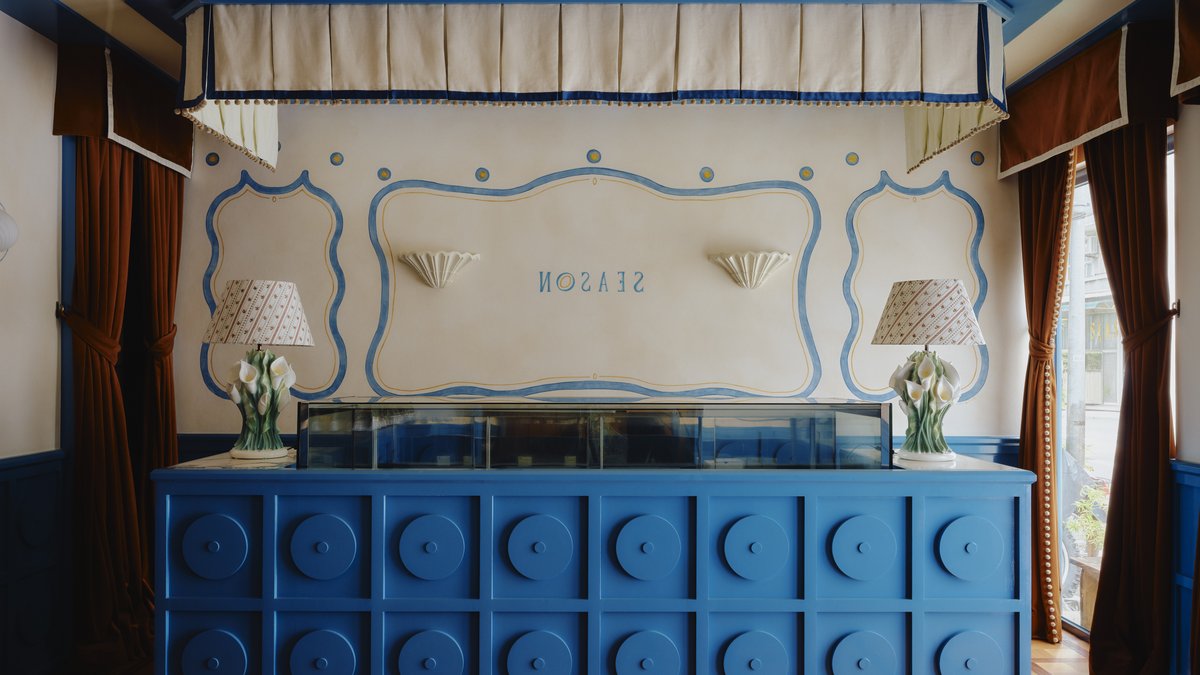
For those seeking French pastry in Taipei, the Da’an District now hosts a distinctive destination known as Season. Designed by Ecru Studio for Chef Hung, recognized as one of Taiwan’s pioneers in traditional French pastry, the space merges historical European aesthetics with local cultural references. The design team drew heavily from 18th-century Parisian salons, integrating Art Deco and Art Nouveau styles alongside Asian motifs to create a unique atmosphere. Jin Chen, co-founder of Ecru Studio, explained that these historical references dictated the spatial rhythm and material selection. “These references informed everything from the spatial rhythm to material choices, allowing us to blend decorative richness with moments of restraint,” Chen said.
The original structure dates back to the early 1970s, offering a neutral starting point for the architects. They faced the challenge of a compact footprint, which they resolved by carving out four specific areas. These include a pastry display, a section for gift items, a lounge modeled after a salon, and a nine-seat island bar. While each zone possesses its own character, the designers ensured they connect smoothly to form a single unit. The designers had to ensure the flow works well across the four distinct zones.
A Fusion of Historical Styles
The visual language relies heavily on Asian elements to ground the venue in its location. Hand-painted murals reference symbols from the Shang Dynasty, while unique Asian textile patterns appear throughout. In the gift zone, the fabric covering twin benches uses abstract, symbol-based patterns found in specific Asian textile traditions. The color scheme shifts from refined blues to deeper, dramatic hues like red, ochre, and gold, guiding visitors through the space. Floral fabrics, velvet, and decorative fringes mix European elegance with a Taiwanese spirit.
Related: IKEA Unveils Playful Functional PS 2026 Collection
This blending of distinct cultural signifiers suggests a shift in how boutique establishments approach branding. Rather than importing a European aesthetic wholesale, the integration of local motifs creates a narrative that feels specific to Taipei while honoring the French culinary tradition. It allows the space to function as a bridge between the chef’s training abroad and his roots in Taiwan, offering visitors a layered experience that goes beyond simple consumption.
Material Depth and Color
Every detail was chosen to reflect emotional depth and visual richness. The flooring features custom wood patterns inspired by Milanese design, adding a layer of texture underfoot. The transition of colors was done to guide guests through the spatial narrative, moving from the calm blues of the retail areas to the warmer, theatrical tones of the seating areas. This shift helps define the different functions of the space without the need for physical barriers.
“As Season entered a new chapter, Chef Hung chose blue as the primary colour,” Chen noted. This decision anchored the fresh pastry and retail areas in varying shades of blue, setting a calm tone for the brand’s identity. The designers collaborated with local artist Genggeng on the mural and looked at antique trim catalogs and vintage packaging for inspiration. Randy Tu, the other co-founder, mentioned that these details required experimentation to achieve an emotionally rich result. “These details required a high level of experimentation and precision, but ultimately helped us craft a space that feels emotionally rich and visually unexpected,” Tu said.
Related: Actiu launches new table system TRAYY
Designing with Restraint
Chen recalled a meeting where Hung discussed his time in France, specifically a philosophy about restraint—knowing when to stop adding elements. This mantra influenced the team to leave one wall partially bare. They wanted the mural to feel like a fragment of memory rather than a forced centerpiece. This choice highlights the collaboration between the chef’s vision and the studio’s execution. The designers referenced antique trim catalogs, vintage dessert packaging and old textile shops to develop the material and color language for the space.
“One moment that stayed with us was during an early meeting with Chef Hung,” Chen said. “He spoke about his years studying pastry in France, and how the philosophy he brought back to Taiwan wasn’t about decoration, but about restraint – knowing when to stop. That line became something of a quiet mantra throughout the design process. It reminded us to let certain materials breathe, to hold back when the space was already saying enough.”


