
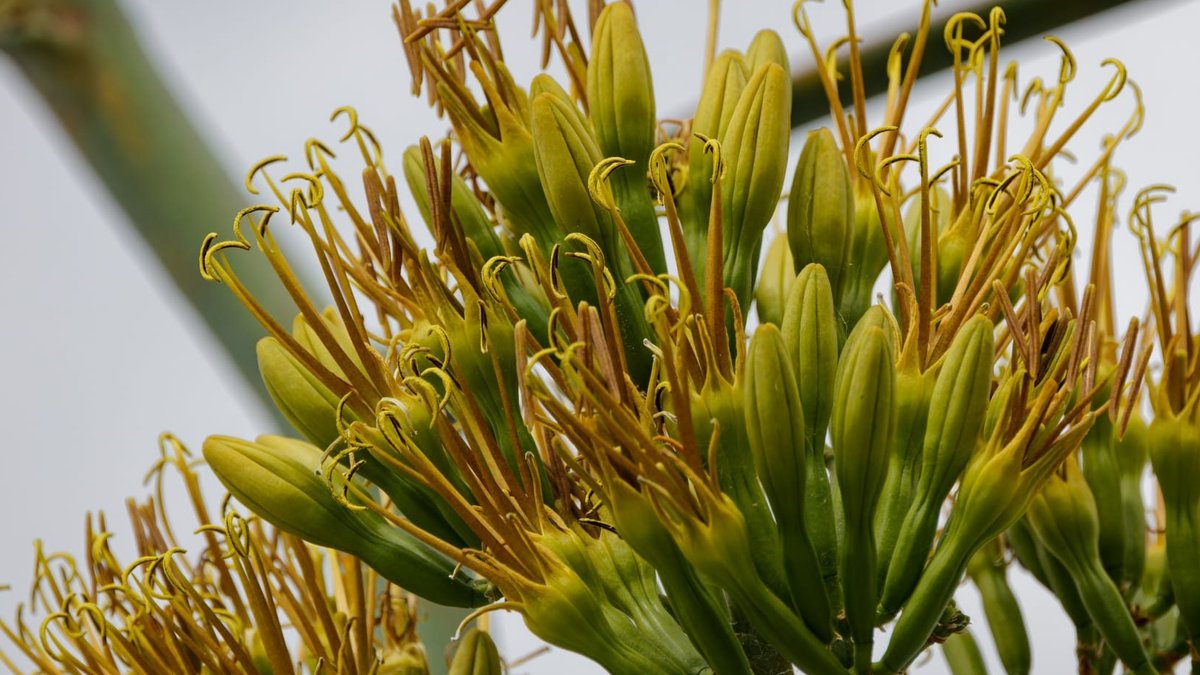
An agave plant at Birmingham Botanical Gardens has entered its final life stage, sending up a towering flower spike that has already pierced the roof of its glasshouse. The Agave sisalana, now 546 centimeters tall—roughly the height of a fully grown female giraffe—is undergoing what horticulturists call a “death bloom,” a rare and dramatic burst of growth before the plant dies.
The last act of a decade-old plant
The event occurs when monocarpic plants—those that flower only once in their lifetime—expend all their stored energy to produce seeds. This particular agave has spent the past decade accumulating resources. In its final months, it channels them into a single, massive flowering display.
“Monocarpic plants are evolutionarily programmed to flower just once, use all their stored energy to make seeds, and then die,” said Alberto Trinco, Senior Display Glasshouse Horticulturist at the gardens. “This strategy maximizes reproductive success in harsh or competitive environments by flooding the ecosystem with thousands of seeds at a single, optimal time.”
The flower spike grows up to 12 inches per day and may eventually reach 14 meters. The entire process, from initial bloom to seed dispersal, can take up to six months. Once flowering ends, the plant will wither but not before scattering hundreds of tiny plantlets—called bulbils—from its stem. Staff plan to collect these for future propagation.
A controlled environment for an unpredictable bloom
Caring for the agave has required precise conditions. During spring and summer, when sunlight and warmth accelerate growth, the plant receives regular water and fertilizer. In winter, the Arid Glasshouse is kept cooler than visitors might expect—around 14°C at minimum—to mimic the plant’s natural dormancy period. Watering stops entirely during these months to prevent rot.
Native to the Americas, the Agave genus includes over 230 species, though few reach this size. While agaves are common in botanical collections worldwide, seeing a “death bloom” in person is unusual, particularly in the UK. The gardens have encouraged visitors to see the spectacle before it fades.
The bloom progresses as the plant’s energy reserves dwindle. The once-sturdy leaves will yellow and collapse, but the flower spike will remain standing. For horticulturists, it serves as a reminder of nature’s efficiency—how a single organism can spend years preparing for one brief moment of reproduction.
The display will last through the coming months, offering a fleeting chance to observe a process that often goes unseen in the wild. Those interested can visit the Arid Glasshouse at Birmingham Botanical Gardens to witness the phenomenon firsthand.
Trinco noted that such events highlight the importance of controlled environments in preserving rare botanical moments.


